Monday, 26 November 2012
Target Audience Research

Wednesday, 21 November 2012
Past Student Thrillers Analysis
We watched past student thriller openings and analysed them we viewed a range of thrillers from different years and I have selected 3 to analyse.
The first clip is Finders Keepers;
This clip works well because it is different from most of the others that attempt a horror approach but this clip has a North by Northwest feel to it with the case of mistaken identity and the chase scene. This clip also makes use of the Macguffin of what's inside the box and the red herring of the man pulling his phone out of his pocket where we expect a gun, this is emphasised by the music coming in to suggest danger, the end also leaves us on a cliffhanger with the main character standing and the two suited men walking towards him. The music is also well chosen to suggest danger in the first part but then it shows how the action will start because the sound is parallel to the action. However this clip is not all good as there is some unsteady camera work on the stairs and the font used doesn't seem appropriate for the fast paced action thriller it seems a bit boring.
The second analysis I did was on The Night Walker;
This clip deals with diegtic sound very well and can be clearly heard over the music . Their are interesting shots used such as the P.O.V. running shot and the mirror shot to show the figure appearing in the back of the car but the camera work does slip at times.. This film however seems to be in 2 unconnected halves whereas one half would make a better opening. The cliché classing roaming the alley way scene is too predictable and doesn't add anything to the clip. The beginning is definitely more intriguing and unsettling because it has more questions and is more visually stimulating.
The third analysis was on Hide and Seek;
This thriller has a supernatural feel with door slamming and the figure moving past the camera but what this does well is that it doesn't give too much away it keeps you guessing. However this clip is let down by the sound because of the change between tracks where it jumps and makes it sound clunky. It is an overall good video it just ties to hard to include as much as possible.
The first clip is Finders Keepers;
This clip works well because it is different from most of the others that attempt a horror approach but this clip has a North by Northwest feel to it with the case of mistaken identity and the chase scene. This clip also makes use of the Macguffin of what's inside the box and the red herring of the man pulling his phone out of his pocket where we expect a gun, this is emphasised by the music coming in to suggest danger, the end also leaves us on a cliffhanger with the main character standing and the two suited men walking towards him. The music is also well chosen to suggest danger in the first part but then it shows how the action will start because the sound is parallel to the action. However this clip is not all good as there is some unsteady camera work on the stairs and the font used doesn't seem appropriate for the fast paced action thriller it seems a bit boring.
The second analysis I did was on The Night Walker;
This clip deals with diegtic sound very well and can be clearly heard over the music . Their are interesting shots used such as the P.O.V. running shot and the mirror shot to show the figure appearing in the back of the car but the camera work does slip at times.. This film however seems to be in 2 unconnected halves whereas one half would make a better opening. The cliché classing roaming the alley way scene is too predictable and doesn't add anything to the clip. The beginning is definitely more intriguing and unsettling because it has more questions and is more visually stimulating.
The third analysis was on Hide and Seek;
This thriller has a supernatural feel with door slamming and the figure moving past the camera but what this does well is that it doesn't give too much away it keeps you guessing. However this clip is let down by the sound because of the change between tracks where it jumps and makes it sound clunky. It is an overall good video it just ties to hard to include as much as possible.
Tuesday, 20 November 2012
James Bond Recipe
James Bond thrillers have become there own genre through the sheer amount of films and the consistent style used throughout the movies.
The things that make up a James Bond film are:
"The opening scenes which are often eye-popping, stunt-driven action form the top shelf of absurdity"
This quote gives us certain points to examine whilst analysing the opening.
This is the opening to Casino Royale with the latest Bond, Daniel Craig.
In these openings we see a fast paced action chase scene one on foot and one in Bonds iconic Aston Martin. These openings include amazing feats that only Bond could achieve such as death defying leaps and precision, life saving driving. The openings provide a reassuring ease into the familiar franchise.
The things that make up a James Bond film are:
- A dashing, sexy, and heroic secret agent. Bonds are usually the same actor for a period of films and there have only been 6 actors in 23 movies.
- An eccentric villain of equal or greater strength than Bond.
- A number of gorgeous women Bond will make love to.
- Exotic locations and plot devices.
- Exciting stunt-driven action. (Often a little absurd).
- The John Barry music.
- A 'pop song' that will promote the film.
- Bond being given his 'mission' by M and Bond receiving his gadgets form Q.
- Fights and car chases.
- Bond being trapped.
- Final scene (often on an island) where Bond overcomes the odds and triumphs.
The openings too Bond film are also a stereotype as they all have to fill an imaginary criteria.
"The opening scenes which are often eye-popping, stunt-driven action form the top shelf of absurdity"
This quote gives us certain points to examine whilst analysing the opening.
This is the opening to Casino Royale with the latest Bond, Daniel Craig.
The way these openings portray Bond is more ruthless and hands on with a colder approach to people. In older Bond openings Bond seems easier going and more laid back whereas Craig portrays Bond as on edge and quite emotionless.
Skyfall
Skyfall is the latest in the Bond genre and is bringing a new depth and scope to the 'comic-book' hero Bond that we have become used to. In this film we are treated to a rich back story of Bond and it has been anointed the best Bond of all time. Skyfall was made with $200,000,000 but it made £304,360,277 in the UK and $1,108,519,023 worldwide, this makes it the 3rd highest grossing James Bond film to date after Thunderball and Goldfinger. This is probably due to the wide fan base and the high advertisement that the film received.
The Manchurian Candidate
The Manchurian Candidate is originally a novel by Richard Condon written in 1959. The novel is a political thriller that tells the story of the son of a prominent US political family. The son is brainwashed into becoming an unwitting assassin for the Communist party.
 The first film version came in 1962 and was directed by John Frankenheimer and stared Frank Sinatra, Laurence Harvey and Janet Leigh.
The story is centred around Major Ben Marco who is an intelligence officer in the U.S. Army. He served valiantly as a captain in the Korean war and his Sergeant, Raymond Shaw, even won the Medal of Honor. Marco has a major problem however: he has a recurring nightmare, one where two members of his squad are killed by Shaw. He's put on indefinite sick leave and visits Shaw in New York. Shaw for his part has established himself well, despite the misgivings of his domineering mother, Mrs. Eleanor Shaw Iselin. She is a red-baiter, accusing anyone who disagrees with her right-wing reactionary views of being a Communist. Raymond hates her, not only for how she's treated him but equally because of his step-father, the ineffectual U.S. Senator John Iselin, who is intent on seeking higher office. When Marco learns that others in his Korean War unit have nightmares similar to his own, he realizes that something happened to all of them in Korea and that Raymond Shaw is the focal point.
The later version was created in 2004 and directed by Jonathon Demme and stared Denzel Washington, Liev Schrieber, Meryl Streep and Kimberly Elise.
When his army unit was ambushed during the first Gulf War, Sergeant Raymond Shaw saved his fellow soldiers just as his commanding officer, then-Captain Ben Marco, was knocked unconscious. Brokering the incident for political capital, Shaw eventually becomes a vice-presidential nominee, while Marco is haunted by dreams of what happened - or didn't happen - in Kuwait. As Marco (now a Major) investigates, the story begins to unravel, to the point where he questions if it happened at all. Is it possible the entire unit was kidnapped and brainwashed to believe Shaw is a war hero as part of a plot to seize the White House? Some very powerful people at Manchurian Global corporation appear desperate to stop him from finding out.
The Opening Sequences
The openings of both films start with Ben Marco, identifying him as the main character, but the older version of the film jumps straight into the dream of Marco and the brainwashing scene whereas the later version shows Marco's life and Al Melvin, a member of the squad, having the dreams.
The flashbacks to the battle scenes in each movie differ a lot. In the recent version it is much more sophisticated and is set in Kuwait. The older version puts the soldiers on a grassy mound set in Korea in a film studio but the recent version has CGI, explosions and night vision and put us in the heart of battle.
The Brainwashing Scenes
These scenes are very different in the films, the older version shows the brainwashing by having the soldiers at a ladies meeting discussing flowers interchanging with the communist organisations operations.

This compares to the advanced technical operations being performed in the more recent version with horrific and graphic scenes of drills and brain implants.
This shows the technical differences between the two films.

Racism
This film also touches on the racial elements from the times. In the 1962 version there are many racial stereotypes for example the token black soldier and the mysterious and dangerous men from the east. However the 2004 version includes a black protagonist an has a multi racial society setting.
Media
The portrayal of the media coverage of both films is relative to the budget and resources they had. For instance the 1962 version has the entire press in one room asking questions which seems very simple and cheap and doesn't create any depth. The 2004 version however creates a deep, realistic feel to the movie because of the resources available the director was able to create a reel of footage spliced from real footage which imitated real news channels.
The Paranoid Thriller
This sun genre of thriller is one we haven't explored and it is very interesting. The main protagonist, the resourceful hero, is trying to regain and unravel his sanity. Marco is represented as a masculine man who has the respect of other men, he is also accustomed to danger and has a record of bravery in the army. This film includes a range of genres psychological, paranoid and political thriller.
These films were made to deliver a message to the public about politics and what could possibly be happening. 'The director elaborates and makes the film bigger than life: sadder, darker and stranger than real life' This seems true because of the extent to which the film thinks the brainwashing could go, I believe that the concept is plausible but the extent with the entire scheme is going too far.
Key Scenes
Murder of Senator Jordan
The first key scene in the film that shows the terror of what can happen with these brainwashed characters is when Raymond commits the murder of Jordan, this scene differs from the original by having Raymond drowning the senator. The drowning creates a dream like state, this could symbolize the main characters drowning, this is reinforced by the fog clouding over the events and removing clarity. There is non-diegetic music used to enhance the tension as Raymond approaches his victim, we regularly see this technique in thrillers. The editing reflects Raymond's hypnotised state of mind.
Marco shooting Raymond and his mother.
This is the climax of the film where Raymond realises what he is becoming and decides to sacrifice himself and his mother to rid the possibility of being owned and operated like a machine. There is an undercurrent hint of the Oedipus complex from the Greek myth. In the novel Raymond's mother uses his brainwashing to have sex with him before the climax but concerned that not even a reference would be made to it because of the censors the film makers have her kiss him on the lips to imply her incestuous attraction to him.
Star Power
The modern version cast a prominent actress as Raymond's mother and this gives her a much larger part than before. This could because of the profile of Meryl Streep because she was an A-lister she would have brought in more money. The new version has two stars with Washington and Streep whereas the previous version had one; Sinatra. This was probably to draw in more people to create a bigger revenue. However Angela Lansbury, who was Raymond's mother in the original, did get an Oscar nomination for her performance, although she was not a big acting star she was still a good actress or she would not have received her ward nomination. Her performance seems very controlled and very planned she shows the diabolically smart plans that are forming in her head.
The End
The final shot of the Manchurian Candidate shows a picture of Mt. Rushmore, which invites viewers to ask questions about past and present leaders and how much we actually know about them and how they gained power. The question "what if?" should always be remembered whilst watching this film. There is always a serious message as this film could be viewed as a reflection of who we are and what society could become. Never believe everything you see.
I think the more recent version was better because of the better resources they had with the CGI and the editing advancements that they did not have in the original. These films differ from other thrillers because they are more complex, we only learn the information as Marco learns it which keeps us in suspense and tantalises us with clue and red herrings.
The first film version came in 1962 and was directed by John Frankenheimer and stared Frank Sinatra, Laurence Harvey and Janet Leigh.The story is centred around Major Ben Marco who is an intelligence officer in the U.S. Army. He served valiantly as a captain in the Korean war and his Sergeant, Raymond Shaw, even won the Medal of Honor. Marco has a major problem however: he has a recurring nightmare, one where two members of his squad are killed by Shaw. He's put on indefinite sick leave and visits Shaw in New York. Shaw for his part has established himself well, despite the misgivings of his domineering mother, Mrs. Eleanor Shaw Iselin. She is a red-baiter, accusing anyone who disagrees with her right-wing reactionary views of being a Communist. Raymond hates her, not only for how she's treated him but equally because of his step-father, the ineffectual U.S. Senator John Iselin, who is intent on seeking higher office. When Marco learns that others in his Korean War unit have nightmares similar to his own, he realizes that something happened to all of them in Korea and that Raymond Shaw is the focal point.
The later version was created in 2004 and directed by Jonathon Demme and stared Denzel Washington, Liev Schrieber, Meryl Streep and Kimberly Elise.
When his army unit was ambushed during the first Gulf War, Sergeant Raymond Shaw saved his fellow soldiers just as his commanding officer, then-Captain Ben Marco, was knocked unconscious. Brokering the incident for political capital, Shaw eventually becomes a vice-presidential nominee, while Marco is haunted by dreams of what happened - or didn't happen - in Kuwait. As Marco (now a Major) investigates, the story begins to unravel, to the point where he questions if it happened at all. Is it possible the entire unit was kidnapped and brainwashed to believe Shaw is a war hero as part of a plot to seize the White House? Some very powerful people at Manchurian Global corporation appear desperate to stop him from finding out.
The Opening Sequences
The openings of both films start with Ben Marco, identifying him as the main character, but the older version of the film jumps straight into the dream of Marco and the brainwashing scene whereas the later version shows Marco's life and Al Melvin, a member of the squad, having the dreams.
The flashbacks to the battle scenes in each movie differ a lot. In the recent version it is much more sophisticated and is set in Kuwait. The older version puts the soldiers on a grassy mound set in Korea in a film studio but the recent version has CGI, explosions and night vision and put us in the heart of battle.
The Brainwashing Scenes
These scenes are very different in the films, the older version shows the brainwashing by having the soldiers at a ladies meeting discussing flowers interchanging with the communist organisations operations.
This compares to the advanced technical operations being performed in the more recent version with horrific and graphic scenes of drills and brain implants.
This shows the technical differences between the two films.
Racism
This film also touches on the racial elements from the times. In the 1962 version there are many racial stereotypes for example the token black soldier and the mysterious and dangerous men from the east. However the 2004 version includes a black protagonist an has a multi racial society setting.
Media
The portrayal of the media coverage of both films is relative to the budget and resources they had. For instance the 1962 version has the entire press in one room asking questions which seems very simple and cheap and doesn't create any depth. The 2004 version however creates a deep, realistic feel to the movie because of the resources available the director was able to create a reel of footage spliced from real footage which imitated real news channels.
The Paranoid Thriller
This sun genre of thriller is one we haven't explored and it is very interesting. The main protagonist, the resourceful hero, is trying to regain and unravel his sanity. Marco is represented as a masculine man who has the respect of other men, he is also accustomed to danger and has a record of bravery in the army. This film includes a range of genres psychological, paranoid and political thriller.
These films were made to deliver a message to the public about politics and what could possibly be happening. 'The director elaborates and makes the film bigger than life: sadder, darker and stranger than real life' This seems true because of the extent to which the film thinks the brainwashing could go, I believe that the concept is plausible but the extent with the entire scheme is going too far.
Key Scenes
Murder of Senator Jordan
The first key scene in the film that shows the terror of what can happen with these brainwashed characters is when Raymond commits the murder of Jordan, this scene differs from the original by having Raymond drowning the senator. The drowning creates a dream like state, this could symbolize the main characters drowning, this is reinforced by the fog clouding over the events and removing clarity. There is non-diegetic music used to enhance the tension as Raymond approaches his victim, we regularly see this technique in thrillers. The editing reflects Raymond's hypnotised state of mind.
Marco shooting Raymond and his mother.
This is the climax of the film where Raymond realises what he is becoming and decides to sacrifice himself and his mother to rid the possibility of being owned and operated like a machine. There is an undercurrent hint of the Oedipus complex from the Greek myth. In the novel Raymond's mother uses his brainwashing to have sex with him before the climax but concerned that not even a reference would be made to it because of the censors the film makers have her kiss him on the lips to imply her incestuous attraction to him.
Star Power
The modern version cast a prominent actress as Raymond's mother and this gives her a much larger part than before. This could because of the profile of Meryl Streep because she was an A-lister she would have brought in more money. The new version has two stars with Washington and Streep whereas the previous version had one; Sinatra. This was probably to draw in more people to create a bigger revenue. However Angela Lansbury, who was Raymond's mother in the original, did get an Oscar nomination for her performance, although she was not a big acting star she was still a good actress or she would not have received her ward nomination. Her performance seems very controlled and very planned she shows the diabolically smart plans that are forming in her head.
The End
The final shot of the Manchurian Candidate shows a picture of Mt. Rushmore, which invites viewers to ask questions about past and present leaders and how much we actually know about them and how they gained power. The question "what if?" should always be remembered whilst watching this film. There is always a serious message as this film could be viewed as a reflection of who we are and what society could become. Never believe everything you see.
I think the more recent version was better because of the better resources they had with the CGI and the editing advancements that they did not have in the original. These films differ from other thrillers because they are more complex, we only learn the information as Marco learns it which keeps us in suspense and tantalises us with clue and red herrings.
Thursday, 15 November 2012
Wednesday, 14 November 2012
Thriller openings
Thriller openings are meant to be intriguing, visually arresting and the titles used to build suspense at the start of the film.
A history of violence
The opening creeps forward slowly as it builds in pace. It opens with a long shot that moves in to a close up. The close up is used to keep things from the audience until the director wants to reveal them to the audience, this is to hide the killings till the director s need to show them. The shot is framed oddly so the focus is trained not on the man but on the door behind him. The sound is also an unpleasant sound as a high pitched buzzing sound which hints at desert. There is also the super contrast of the child being murdered to the child screaming.
Zodiac
Zodiac starts with a pleasant feel and pleasant music and again starts slowly and builds up to a climax of something unexpected. It becomes tense when the car pulls up behind the other car blocking them from leaving and the girl becomes worried and seems to know who it is which makes up question her and what she is hiding. However the tension drops as the car leaves until we hear the screech of tyres as the car comes back and we know its going to end badly. The music starts as the car radio but progresses to get louder and become diegetic and is contrapuntal to what is happening in the shot because of the lively warm nature of the music and the dead bodies. This setting however brings the connotation that something bad will happen because its isolated and the two are attempting some romantic activities.
No country for old men
The framing of the opening shot shows the villain in shadow with just the outline visible. We don't see the villain for as long as possible as the director chooses shallow focus to show the figure getting up and manoeuvring himself into a position to attack the sheriff who is in focus. The villain then attacks the sheriff ans strangles him, the canted angle of the birds eye view of the struggle and the sink when he is washing his hands. This shots show the position of power over the other characters. We then see a police car driving along the road which could be a flash back to when the villain was arrested but it is still ambiguous because the villain is actually in the police car. The murder that follows is very unique and contrast between the calmness of the second murder and the violent struggle of the first. Again this clip builds up slowly and then bursts into action.
A history of violence
Zodiac
Zodiac starts with a pleasant feel and pleasant music and again starts slowly and builds up to a climax of something unexpected. It becomes tense when the car pulls up behind the other car blocking them from leaving and the girl becomes worried and seems to know who it is which makes up question her and what she is hiding. However the tension drops as the car leaves until we hear the screech of tyres as the car comes back and we know its going to end badly. The music starts as the car radio but progresses to get louder and become diegetic and is contrapuntal to what is happening in the shot because of the lively warm nature of the music and the dead bodies. This setting however brings the connotation that something bad will happen because its isolated and the two are attempting some romantic activities.
No country for old men
The framing of the opening shot shows the villain in shadow with just the outline visible. We don't see the villain for as long as possible as the director chooses shallow focus to show the figure getting up and manoeuvring himself into a position to attack the sheriff who is in focus. The villain then attacks the sheriff ans strangles him, the canted angle of the birds eye view of the struggle and the sink when he is washing his hands. This shots show the position of power over the other characters. We then see a police car driving along the road which could be a flash back to when the villain was arrested but it is still ambiguous because the villain is actually in the police car. The murder that follows is very unique and contrast between the calmness of the second murder and the violent struggle of the first. Again this clip builds up slowly and then bursts into action.
Tuesday, 13 November 2012
Sir Alfred Hitchcock

Alfred Joseph Hitchcock was born in 1899 in Leytonstone, England. His early work consisted of successful British silent films and some early talkies before he took his career to the next level in Hollywood.
Hitchcock was a pioneer in Hollywood and created his own distinctive style that mimicked voyeurism, forcing the audience to become the voyeur. Hitchcock's films freely used violence, murder and crime to create a suspenseful, psychological thriller. Hitchcock uses the themes of psychoanalysis to examine the characters and also allows him to use some strong sexual overtones. Hitchcock also used his Macguffin in his films to give the film a motion and make it flow but this Macguffin could often be forgotten about or only come into play at the ned of the movie. Hitchcock was also an expert in editing creating the maximum fear, anxiety and empathy in each one of his films..
Hitchcock directed over 50 films in his 6 decade long career. The shear volume of his films allowed Hitchcock to show all of his talent and to express all he wanted to as a filmmaker.
This is Hitchcock's full filmography although his most famous films are Rear Window, Psycho and North By Northwest. We have watched both Psycho and The Birds in our Media lesson.
However Hitchcock was not only interested in films he was also a TV personality with his television series "Alfred Hitchcock Presents". This television success make him into a celebrity not just a name, he became an icon with his mannerisms and his distinct voice although this also made him the subject of parody. Hitchcock also lent his name to books and a monthly magazine and even after his death "The Late Alfred Hitchcock Presents" was released on radio with Michael Roberts impersonating Hitchcock.
The Birds
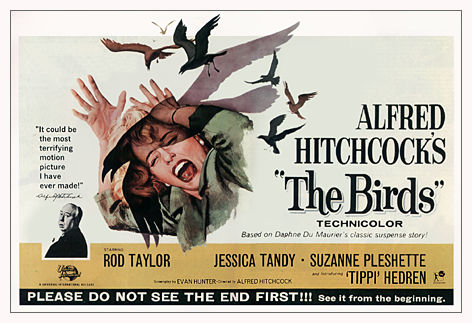
The Birds was released in 1963 and was a horror-thriller directed by Alfred Hitchcock and written by Daphne Du Maurier and Evan Hunter. It stared Rod Taylor, Tippi Hendren and Suzanna Pleshette.
The Birds fits into an archetypal thriller by having fast paced and frequent action this occurs most often with the attacks of the birds. The attacks come at irregular intervals but because of this they hold us in suspense for when the next attack will come. The attacks keep driving the film on and get more serious and violent and become much larger scale. Hitchcock builds up the attacks one after the other to reach a climax for the final assault from the birds.
The hero in The Birds is resourceful and is handy with tools and can take control against the vastly larger and stronger threat of the birds. The birds are much better equipped with numbers on their side but also natural weapons such as beaks and claws which the humans have to overcome.
The Birds is full of suspense because of the imminent strikes of the birds its keeps us on edge as to when the birds will strike for example the crows in the playground, we can see them lining up the attack but the woman cannot see. This builds the suspense as more and more crows join the flock we are waiting for the attack.
Thrillers usually have a villain driven plot where the hero must overcome obstacles but in The Birds the plot is driven by the delivery on the love-birds. The love-birds are a MacGuffin because they are just there to bring the two characters together at Bodega Bay.
In the scene where Tipppi Hendren is attacked by the birds, the birds were attached to her by nylon threads so the birds could not get away from her, this scene took a week to film. During this attack of Hendren claims to ave not been told what was going to happen she was only told to go up the stairs and open the door. Hitchcock then had live birds thrown at her to create a natural effect. Hendren also claims she was wounded in the face by one of the birds.
 The film is interesting because of the way it is made. It features 370 effects and the final scene is made up of 32 separately filmed composites.
The Ending of the film had a few different variations. One that was considered was to have a shot of the Golden Gate bridge covered with birds. However Hitchcock does not finish it with the usual "The End" because he wanted to give the impression of unending terror, and as the birds take over the screen this shot is synonymous with the birds taking over the world. Another ending that was being considered follows the car through the town with the chaos and destruction. This ending made it up to almost being filmed with the crew setting up the town for the final scene but the co- writer Evan Hunter explains how time consuming the original ending was.
For the UK premier of The Birds in London, Leicester Square, Hitchcock greeted the viewers with bird screeches from loudspeakers hidden in the trees after the film to further scare them.
The hero in The Birds is resourceful and is handy with tools and can take control against the vastly larger and stronger threat of the birds. The birds are much better equipped with numbers on their side but also natural weapons such as beaks and claws which the humans have to overcome.
The Birds is full of suspense because of the imminent strikes of the birds its keeps us on edge as to when the birds will strike for example the crows in the playground, we can see them lining up the attack but the woman cannot see. This builds the suspense as more and more crows join the flock we are waiting for the attack.
Thrillers usually have a villain driven plot where the hero must overcome obstacles but in The Birds the plot is driven by the delivery on the love-birds. The love-birds are a MacGuffin because they are just there to bring the two characters together at Bodega Bay.
In the scene where Tipppi Hendren is attacked by the birds, the birds were attached to her by nylon threads so the birds could not get away from her, this scene took a week to film. During this attack of Hendren claims to ave not been told what was going to happen she was only told to go up the stairs and open the door. Hitchcock then had live birds thrown at her to create a natural effect. Hendren also claims she was wounded in the face by one of the birds.

For the UK premier of The Birds in London, Leicester Square, Hitchcock greeted the viewers with bird screeches from loudspeakers hidden in the trees after the film to further scare them.
Monday, 12 November 2012
The Delivery Guy (Our Preliminary Task)
For our preliminary task we had to demonstrate the use of an eye-line match, match-on-action, 180 degree rule and the shot reverse shot. The eye-line match we used was of the delivery man looking at his watch, this lead into the graphic match between the two clocks in the different rooms. We also stuck to the 180 degree rule and we achieved the shot reverse shot through the phone conversation. Our match-on-action came with the door opening and closing on two occasions. We also had some rules to adhere to these were; Character A walks toward a closed door, Character A enters through the door and crosses the room to where Character B is seated, Character A+B exchange a few lines or dialogue, Character A+B exchange a few lines or dialogue and Either Character A or A exit the room. We stuck pretty close to these rules and only the last one we didn't do because we thought it better to end the scene with character A being 'killed', however we added it in at the start so the number of 'door' shots were the same.
I believe our preliminary task worked well because of the organised way we set it up and scripted it compared to previous tasks. We filmed in a chronological order as this seemed most logical and it went well as we hardly had to re film or come back to previous shots. This style of filming was good for us as we could see the tension and the build up to the climax unfolding through the film without us giving away any hints to the anti climax. The idea of the anti climax stemmed from the red herring concept where the audience is led to believe something that is false. Our take on the thriller was to add an air of comedy for the anti climax instead of the usual mystery packages exchanged in thrillers such as weapons, drugs or information we used a sandwich. However the consequences of the wrong package being delivered are typical of thrillers.
There a few criticism in our task. Things we noticed were;
I believe our preliminary task worked well because of the organised way we set it up and scripted it compared to previous tasks. We filmed in a chronological order as this seemed most logical and it went well as we hardly had to re film or come back to previous shots. This style of filming was good for us as we could see the tension and the build up to the climax unfolding through the film without us giving away any hints to the anti climax. The idea of the anti climax stemmed from the red herring concept where the audience is led to believe something that is false. Our take on the thriller was to add an air of comedy for the anti climax instead of the usual mystery packages exchanged in thrillers such as weapons, drugs or information we used a sandwich. However the consequences of the wrong package being delivered are typical of thrillers.
There a few criticism in our task. Things we noticed were;
- The foot in the background - we did not notice this until we were almost finished and did not have time to re-film it however it is not as extremely noticeable.
- Our sound could also be criticised because it stops without us seeing it being switched off or turned down but this is not a big problem and we don't believe many audiences would notice.
- We could also criticise the camera work toward the end, we attempted a very tricky moving tilt which worked quite well although it was a bit rough and not as smooth as we would have liked. We did choose to include it though as we thought it was a good experimental shot.
Continuity Editing
This kind of editing is naturalistic and meant to be invisible. It is designed to create a sense of realistic chronology and generates the feeling that time is moving forward. However flashbacks or flash forwards may be used but the narrative will still be seen to be progressing forward in an expected or realistic way.
Techniques used in continuity editing are:
Eye-line Match - We see the character looking at something off screen and then we cut to a shot of what they are looking at.
Match-on-action - We see a character start an action in one shot and then we see them continue it in the next. We could also see the start of an action from one perspective then the next perspective carries on the shot of the action.
Graphic match - The film maker can choose to place shots in a certain order so as to create a smooth visual transfer from one frame to another. This technique uses two shots of a similar shape consecutively.
Another important technique is the 180 degree rule:
This rule is a basic guideline that states that two characters (or other elements) in the same scene should always have the same left right relationship to each other. If the camera passes over the imaginary axis connecting the two subjects, it is called crossing the line.
 This diagrams shows the imaginary line and what happens when you cross it.
Techniques used in continuity editing are:
Eye-line Match - We see the character looking at something off screen and then we cut to a shot of what they are looking at.
Match-on-action - We see a character start an action in one shot and then we see them continue it in the next. We could also see the start of an action from one perspective then the next perspective carries on the shot of the action.
Graphic match - The film maker can choose to place shots in a certain order so as to create a smooth visual transfer from one frame to another. This technique uses two shots of a similar shape consecutively.
Another important technique is the 180 degree rule:
This rule is a basic guideline that states that two characters (or other elements) in the same scene should always have the same left right relationship to each other. If the camera passes over the imaginary axis connecting the two subjects, it is called crossing the line.

Donnie Darko Opening
I have been researching thrillers by watching more types of thrillers to gain more of an insight into what makes a thriller and how thrillers vary. We are making the opening of a thriller so I watched the opening of Donnie Darko and commented on the features it offers.
It opens with credits in an unusual font which alerts up because it is different from what we are used to seeing. there is then an extreme long shot panning across a forest. The camera comes to rest on a body laying in the road, this brings up questions and we almost immediately we jump to the conclusion he is dead because of what we know of these films. As the camera moves closer we see a bike and assume the person has been knocked down but he moves and sits up which would be very confusing as it is unexpected. The camera provides a close up of the boy before cutting away to the landscape again. The boy enters the shot unusually from the bottom and he then turns and laughs, this is very unexpected and rather creepy. This would pose many questions to the audience and make the character very intriguing but we do learn his name on an assumption as it comes up across the screen as he leaves the shot. The sun becomes brighter and the screen fades to white, the director does this to jump settings and time to the boy on his bicycle riding along. The director focuses on a sign by cutting to it to show us the date and place where the action is set, this is also intriguing because we learn that it is Halloween and bad things happen at Halloween. The time seems like morning and he is wearing pyjamas which poses the question as to whether he has been out all night and where has he been. The family are shown as a happy typical family apart from the boy who is dark and mysterious. The opening finishes with the boy as calm as can be walking into his house and going to the fridge like nothing is out of the ordinary.
The cinematic techniques are very important in this film. The first shot is the normal establishing shot of the long shot of the setting panning into a tracking shot The long tracking shot used as a zoom on the character gives a strange feel because it is not a zoom but a tracking shot. The director includes a lot of long shots during the opening, and cuts between them to keep the action moving along but the cuts show how the time passes as it takes him a while to get home. There is a lot of non-diegetic sound in this opening, mostly from nature, thunder and birds are used at the start. However there is some sad music which shows that something is wrong , but this contrast with angelic music as he stands up and the upbeat music towards the end. The song was called “The Killing Moon” which shows how the mood of the movie will pan out.
There is also some interesting aspects of mise-en-scene in this opening because of the book being read is “It” by Stephen King who is a horror writer this shows how the film will pan out but the most noticeable is the message “Where is Donnie?” on the fridge which seems creepy and makes us asks the question of who has written it and why.
Subscribe to:
Comments (Atom)